Monday, November 10, 2014

Germany: An Identity Crisis


The end of World War I in 1914 was one of the first great struggles that Germany was about to face.  While the war was not fought on their soil and therefore did not create much damage to their physical homeland, the damage done to their pocket books very great.  After losing this war, the Allies were making the Germans pay.  They were forced to give up a great deal of their land, and the requirements for demilitarization left them with an army that was more like a police force that left Germany incapable of defending itself (203).  This caused them much despair.  Not only were they attempting to recover from the war, but they were in the midst of building their government, the Weimar democracy.  However, due to the fact that the democracy emerged, not as the product of an elected parliament and strong political parties, but of a general staff at its wits’ end, and that it came into being at the worst time, this democracy was not able to last for very long (197). This once again left Germany lost and looking for a place to turn.  It was often difficult for Germany to form an identity because they were so often thrown around from government to government, and the consistency they had once had as small individual states was long gone.  They were looking for something that could give them consistency once again.  This is where the Nationalist Socialist party stepped in.  It was quite easy for them to gain
Adolf Hitler truly believed that he was doing God's
work by eliminating anyone who did not fit into
the Aryan supremacy.  He was actually a very
Catholic and religious man.
power in Germany because the people were so lost and looking for a leader.  The things that the Nationalist Socialist party talked about sounded very good to the Germans because at this time, they had practically nothing.  However, this government was not all that they appeared to be.  While Adolf Hitler truly did want Germany to be successful, his tactics were far too extreme and created massive issues that the entire world was offended by.  This is how the Second World War began.  The Germans, still trying to find their identity as a country, went along with the things that Hitler did without much resistance.  Although Germany put up a large fight, they ultimately lost the war, and their leader committed suicide.  They were once again left a broken country with an identity crisis.  They now had to deal with the moral destruction wrought by the violent dictatorship, the war, and full knowledge of the horrors of the mass murders committed in the extermination camps, and somehow come back from this and form a functional country (287).  Additionally, Germany was divided up into four parts after the Second World War ended, which made it hard for Germans to form their own identities again because they were being ruled by people who were not German.  Each section was telling them how to run their government, and putting the people they wanted into power there.  While all this was happening, the German people were scavenging for food because there was such a shortage of the most basic goods, clothing, and especially food (286).  "Whether Germany even still existed as a nation state was an open question, but one to which most Germans were heartily indifferent.  Surviving to the next day was what counted" (287).  They were rather unconcerned with the politics at the time, and more concerned about living.  Not knowing whether or not they would live to the next day made it very hard for these people to consider what kind of life, government, or morals they wanted their country to have.  As this continued and the fate of German government was being further discussed
A man taking part in the "denazification program" by replacing
things named after Hitler to be named after more noble men.
among the Allies, it was agreed up that every German adult was required to undergo the "de-Nazification" process (289).  However, in each different zone, this looked very different, so all of the Germans were getting different ideas of what it meant to be a citizen of the world.  The American sect was pushing a democratic view onto their zone, however the mass amounts of questions on the questionnaire, arbitrary judgments in court, protests and more were sending confusing messages to the Germans about what democracy was really about.  This also made it very hard for Germans to determine how they felt about democracy or government policy in general.  Finally though, after much time spent as a divided country, they were finally able to create an early form of the German Democratic Republic that had a permanent goal of creating a full German nation state (297).  They would eventually be able to form their identity as a nation through this, although they still struggle with the morality of their rough 
history today.

Word Count: 780

Sources:
Schulze, Hagen. Germany: A New History. Cambridge, MA: Harvard UP, 1998. Print.
http://www.ushmm.org/information/press/press-kits/traveling-exhibitions/state-of-deception/denazification-program-in-germany
http://history.howstuffworks.com/world-war-ii/national-socialist-german-workers-party.htm

Wednesday, October 22, 2014

Becoming A United Germany

Map of Germany as it is in 2014.
If someone were to look at a map of Germany today such as the picture above, they would see a decently sized country united by a definitive border.  However, if someone were to look for a map of Germany in the 1600s or 1700s, they would see an area divided by about three hundred states as shown in the picture below.
Map of German speaking lands and the Holy Roman Empire in 1789.
Germany at this time was not what we would today consider to be a country.  It was not even a united area.  These more than three hundred principalities functioned completely on their own, but were just very close together because of how small they were.  The one thing that truly connected these small states was the language.  They did not have the exact same dialect throughout all of these principalities, but all of them spoke a variation of German.  "In the seventeenth and eighteenth centuries "German" still referred only to a language, nothing more, and at times even the prospects for its future were murky" (86).  As time went on and wars such as the thirty years' war took place, these small nations occasionally worked together to take on larger countries that threatened their territory.  However, none of the states ever had the desire to become one nation.  It was occasionally brought up in jest, but no one truly wanted a united Germany; they liked things just the way they were.  Eventually though, after many battles and losses, after treaties signed, abandonment of alliances, and the two powers' plan for compensation, the principalities had to ban together to form thirty states instead of the original three hundred and fourteen (97).  Even after this, the German states did not want to become united.  This condense was drastic enough for them.

Soon after this, Napoleon came into power.  As he worked to extend France's reign and power, German states worked to defend themselves against him.  They banned together to stop him from expanding into their countries.  While this was happening, words such as "fatherland" and "nation" emerged for the first time (104).  A sense of nationalism had started to surface in German speaking lands during this time, emulating a sense of unification.  When Napoleon was finally defeated and the Thirty Years' War ended, the Germans were filled with joy, unlike when the Holy Roman Empire collapsed and they did not appear to care one way or another (106).  This lead to a flood of nationalism with citizens rushing to help the cause of rebuilding and volunteering, even poets wrote frequently about the demise of Napoleon.  This really brought the states together.  Even after this large commotion simmered down and live went back to normal, German people were hoping that the nation states could keep their unity for the first time.  From here there was an attempt to unite, but there was still too much disconnect between the states.  There needed to be a quicker way for goods to be moved around.  This is where the first German railway line came in.  This allowed for the more swift transportation of goods,  opened up many jobs, and created quite a bit of an economic rise.

Finally, Otto von Bismarck came into power as the new prime minister.  He got involved in and won several small wars with Austria and France.  This allowed Germany to became a dominate force as seen by other countries, and led to its true unification.  The official unification of Germany took place on January 18, 1871 (145) and continues as one solid nation today.

Otto von Bismarck is responsible for the final and official unification of Germany as one country in 1871.
Word count: 625

Schulze, Hagen. Germany: A New History. Cambridge, MA: Harvard UP, 1998. Print. 
Wolf, G.H. "Germany." GLS 362 Meeting, Room 11, Oesterle Library, Naperville. 24 September, 2014. Lecture.

http://www.wwnorton.com/college/english/nael/images/20thc/Bismark.jpg 

http://geocurrents.info/wp-content/uploads/2011/04/Holy-Roman-Empire-1789-300x206.jpg


http://www.google.com/maps/vt/data=U4aSnIyhBFNIJ3A8fCzUmaVIwyWq6RtIfB4QKiGq_w,MEkRX9WBZwfBZilt7sAiiH9BwpfbHmh-ZkZ8x-2j9WElNMhHqT3mgt8XxcWfeQMVKhni_mTZ_MZrK71YIIE1s61uvCWA-xSWonGJETmuaGwMmiGsAXGvW2MLZKJTfZxu5MwQQh9pekjUzqDzaTCIQxDnEkGjsa8qiOCQCFX3ufmxKFzbRIsK0Fs-dIsnJ5zFWdChKeHx3R0bar81ig

Friday, September 12, 2014

"Ich Bin Ein Berliner"


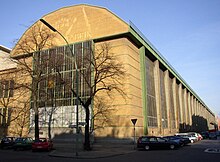
            One thing I found really interesting when learning about Berlin’s history is how important their buildings are to them.  I felt an extra special connection to this since we will be visiting many, many buildings while on our Germany excursion.  The videos talked often about how the remains of the buildings were just as important to them as the buildings themselves.  They said that demolition is equal to construction, and that was the curse of the city.  It was incredibly difficult for them to decide what to do with different buildings, and everyone had very strong opinions about them.  Before World War II, Berlin was a very progressive and modern city.  Peter Behrens created the turbine factory idea, which changed the course of architecture with modernism.  It was the first of its kind and led the way in modern architecture.  However, once Hitler came to power, Berlin lost its modern edge.  I find it interesting though, that while Hitler destroyed that forward push in modern architecture, he was still working to keep it.  He had attempted to build the biggest and the best stadium so that the Olympics could be held in Berlin every year.  Although it was never completed, the desire for progressive architecture was still present.  Not only was being progressive an important part of Berlin architecture, but the sentiment.  The current German Ministry of Finance building used to be the Nazi Ministry of Aviation.  The people who work there today have expressed creepy feelings they often felt while being there.  They say that the spirits are still in the walls.  Similarly, the famous building Schloss held a great deal of history.  Many Germans believed that it represented the wrong kind of history, so they did not want its remains in their city.  Therefore, it was demolished in 1950 even though it was Berlin’s most historic building.  Its demolition created an even further divide between the east and west sides because they were split about its destruction.  The Palace of the Republic than replaced the famous Schloss for many years.  Recently, the Palace of the Republic was torn down and a new Schloss was put in its place.  All of this demolition and reconstruction has caused much stress and hard feelings upon the German people because they take these building changes so seriously.  One last example would be the Berlin wall.  While some of its remains are still up and around, currently a tourist art gallery attraction, most native Germans find disgust with the wall and what it represents.  The buildings are an incredibly important part of being a Berliner.
            Another important part of being a Berliner would be understanding the city as a whole, and I think that the East side of Berlin is commonly misunderstood.  It is often viewed as being a harsh, solitary country that did not allow anyone in or out.  However, these ideas create some misconceptions.  While East Germany was certainly more harsh than West Germany, not all citizens felt that way.  Some, such as the couple from the documentary, were very distraught by the reunification of East and West Berlin because they like and believed in the ideals of East Berlin.  The particular couple in the movie went into a deep depression because of their new lives in the unified Germany.  They far preferred it when East Berlin was its own country.  If it was so horrible and harsh, I do not believe anyone would have been so negatively affected by the reunification.  Secondly, East Berlin was not nearly as secluded as one might believe.  They were not allowing people to easily flow between East and West Germany because they were on bad terms with one another, but that does not mean that no one came in or out of the county ever.  In fact, many Vietnamese people had been welcomed into East Germany.  Their acceptance of the Vietnamese may have been to form an alliance or simply because they had similar values, but no matter the reason, they were welcomed in the country regularly.  This small country was said to be like a dreamland for these people.  It was not until the reunification of East and West Berlin that the Vietnamese were shunned out for “taking German jobs.”  Additionally, both sides were responsible for the wall’s construction in the first place.  I believe that East Berlin is a widely misunderstood part of German history. 
Word Count: 733

 The AEG turbine factory designed by Peter Behrens was the first building of its kind.  This was the beginning of the modern and progressive architectural period in Germany.  They were leading the way in the world of architecture.

This is the original and famous building Stadtschloss or Schloss for short.  Its demolition and replacement buildings are still a large topic in Germany today.

The remains of the Berlin wall have become one of the leading tourist attractions in Berlin, Germany.  While many people go there everyday, the people who live there, Berliners, find must disgust in this wall.  They do not like where the wall comes from or what it represents.

Even though both sides contributed to the building of the wall, East Berlin's strict boarder rules have shaped the way that their side of Berlin was and is still viewed today.  It is interesting that many people were able to escape to West Germany despite the constant watch of the boarder guards.  Those who were determined to leave did their very best to make their way over to West Berlin.

Sources: Frei, Matt. BBC Berlin History 15 part series. Youtube.
http://mentalfloss.com/article/28517/8-creative-ways-people-went-over-berlin-wall
http://www.toptenz.net/top-10-reasons-to-visit-berlin.php
http://en.wikipedia.org/wiki/City_Palace,_Berlin
http://en.wikipedia.org/wiki/AEG_turbine_factory

Tuesday, September 9, 2014

Martin Luther


Martin Luther was an incredibly influential man in many ways.  He was culturally, politically, and religiously influential, and he made an incredible impact on German-speaking lands.  He was determined to make an impact, and did not give up even when the circumstances seemed impossible. 
To begin, Martin Luther made a large impact culturally.  When Luther first began his reformation, the church and the government were essentially one.  Not only did the church make many of the political decisions, they also determined who would go to heaven or hell.  They abused their power, telling people that only those who gave a substantial amount of money to the church, or did something in favor of the church would make it to heaven.  Martin Luther changed the way that people viewed the church and created some separation between the government and the church.  He made people see that the church did not determine whether they went to heaven or hell, but how they acted in their lives, and what was in their hearts did.  He gave the people a voice and created a revolution.  He even gave people access to their own bibles when he later transcribed the bible so that other Germans could read it.  All of these things gave people the ability to make their own judgments on what was right and wrong, and that was very different than these people had ever known before.
Similarly, Martin Luther made some very daring political changes.  The separation eventually created between church and government was obviously the most drastic change he was a part of.  However, he made some smaller, but strong political transformations in other ways.  For example, Martin Luther made what could be considered the first political cartoons.  He outwardly confronted and questioned the government, something no one else dared to do.  He gave people a chance to fight against the Holy Roman Empire and become the countries they are today.  It is possible that none of that would have happened if Martin Luther did not get the ball rolling with his 95 theses. 
            Martin Luther additionally made some very incredible alterations to religion, and that is what he is most known and remembered for.  Through his studies of the written word, Martin Luther came to the realization that people are not required to jump through all of the hoops that the church had created to make it into heaven.  He then created his own version of what he believed was the right way to be a Christian.  This turned into the Lutheran denomination.   Luther had created the first break away from the Catholic Church.  In addition, when he transcribed the bible, he made it accessible to those who were never able to read it before.  He even added pictures for the illiterate.  This allowed people to read and decide for themselves what the best way to follow and glorify God was.  This was certainly a new and radical idea in the religious world.
            All of these things made Martin Luther a hugely influential figure in the German-speaking lands.  However, he did even more than that for these people.  He wrote other books and spoke out to others about how they were being mistreated and tricked by the Holy Roman Empire.  He gave them their voice by being the first one to speak out.  He started a revolt against the church so that these people could be free to follow God in their own way.  He continued on without fail even when he was punished and excommunicated.  He believed that although he was being chastised now, future generations would be able to look back upon what he had done and continue to make things right.  Martin Luther made a huge difference in a wide variety of ways.
Word Count: 626
Martin Luther posted his 95 theses on the church doors for everyone to see.  These theses were a list of the things that Luther thought to be the correct way to follow God's word, as well as things he thought were wrong about the Catholic Church.  This was a major event that caused a huge uproar in the community and was the start of his reformation.  

The bible had once only been available to those who spoke its language and were literate enough to read it.  Martin Luther changed that when he transcribed the bible into the German language.  He additionally added pictures so that illiterate people could understand it as well.  This was a major change in the way religion was practiced.

The church was, as expected, very upset by the ruckus that Martin Luther was causing in the community.  They attempted to get rid of him by excommunicating him from the church, which meant that he was destined for hell.  However, Martin Luther chose to ignore their excommunication and made a point out of it.  He burned the papal ball that symbolized his excommunication to show everyone that he would no longer be under the control of the church.

Citations: http://www.youtube.com/watch?v=ni l gupkGAWO
http://www.the-highway.com/95THESES.html
http://en.wikipedia.org/wiki/Luther_Bible
http://www.123rf.com/photo_17228408_martin-luther-burns-the-papal-bull-ordering-his-excommunciation-from-the-roman-catholic-church-origi.html

Wednesday, September 3, 2014

Holy Roman Empire and American Government


            As I was reading this chapter, one of the things that really jumped out at me were the similarities between the way that the Holy Roman Empire was ruled before Germany was its own country, and our own American government.  Hagen Schulze explains their first constitution, Emperor Charles IV’s Golden Bull, by saying the document “made the German king dependent on the chief nobles of the realm” (32).  This strongly reminds me of our own three branches of government.  Like the executive, judicial, and legislative branches check and balance one another so that no one can become too powerful, the King is kept in check by the chief nobles.  Additionally, the king was “imperator electus,” or an elected emperor.  This is similar to the President of the United States because both are elected, not just put in place because of inheritance or by overthrowing their predecessor.  They are also both elected by a select group of people.  While everyone votes in the United States, the true electing is done by the Electoral College.  Likewise, in the empire the electing was done by the prince electors.  One last thing that the Golden Bull did was separate church and state by making no mention of the pope.  While they still expected people to follow in the Catholic religion even though it is not explicitly stated, it was one step toward religious freedom.  It is interesting to me that democracy in these subtle forms was present so long ago.  We often view past governments as all being ruled by an inherited monarch where no one else had any say, but this is simply not true for all governments.  One last similarity between the Holy Roman Empire and American Government is that there are comparable “federal” and “state” governments.  The Holy Roman Empire consisted of a huge area of smaller states, cities, and towns.  The empire did not have the time or power to watch closely upon each smaller section, therefore “most towns and cities of the empire belonged to the territory of one principality or another and were governed by its ruler” (39).  This is an unintentional form of “state governments” such as the United States have.  The “states” must follow under the rule of the governments set in place by the governor of that state, but also by the guidelines set in place by the larger “federal government.”  I must wonder how much of these governing techniques are still present in Germany today.  When they became their own country, how much did they change?  How does the German government now compare to today’s American government?  I would be very interested to compare and contrast the two governments in modern times.

Word Count: 448
Citation: Schulze, Hagen. Germany: A New History. Cambridge, MA: Harvard UP, 1998. Print.

The image above is Emperor Charles IV’s Golden Bull, the first constitution of the Holy Roman Empire.  It got its name from the gold seal attached to it (32).

The prince electors were a group of men who voted on the election of the emperor.  This group was clearly defined within the Golden Bull and consisted of the archbishops of Mainz, Cologne, and Trier; the King of Bohemia; the Duke of Saxony; the Margrave of Brandenburg; and the Count Palatine of the Rhine (32).


Picture Citations:
http://www.altfrankfurt.com/spezial/Kaiserkroenung/GoldeneBulle.htm
http://en.wikipedia.org/wiki/Prince-elector